
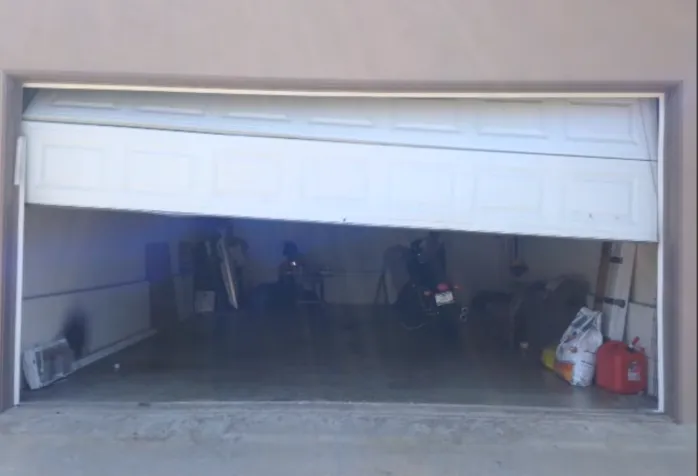
Garage Door Off Track in St. Cloud, FL: 7 Safe Steps
A garage door off track is one of the few home problems where the right first move is to do nothing at all. If your garage door off track problem shows as a crooked door, a roller out of the track, or a door stuck open, stop using it right away. Do not press the remote again, do not force the door, and do not try to push a roller back in with your hands. A garage door off track is heavy, it is held by parts under spring tension, and every extra press of the opener can bend the track further, crease a panel, or let the door drop.
This guide gives you the safe steps first, then the causes, the cost context, and the prevention plan. It answers the questions homeowners ask most on public forums and in trade guides: can I push it back myself, is a slightly off door safe, why only one side, what if my car is trapped, and what should I tell a technician. Each section starts with the problem and ends with the solution, so you can act even if you only read one section.
A garage door off track means rollers have left the metal track guiding the door. Stop using the opener, keep people, pets, and cars clear, and do not force the door. Do not pull the release cord if the door is up. Look from a safe distance for a crooked door or slack cable, then call in St. Cloud on (407) 674-3803, price confirmed before work.
Garage Door Off Track: What It Means
A garage door off track happens when a roller leaves the steel track on one side of the opening. The door rides on rollers inside two tracks, one vertical and one horizontal on each side. Springs and cables lift the door, while the tracks keep it straight and level. When a roller leaves its track, that side of the door is no longer guided, so the door can jam, tilt, scrape, or refuse to move at all.
The opener cannot tell that a roller is out, so it keeps pushing or pulling a door it cannot guide. That is why a small problem grows fast: one more press can bend a track, pull more rollers loose, or strain the opener motor. A garage door off track is also a symptom, not just a fault on its own. The roller that popped out may be visible, but the real cause may be a worn roller, a loose bracket, a slipped cable, a broken spring, or a bent track section.
| Garage Door Off Track Part | What It Does | What Goes Wrong |
|---|---|---|
| Rollers | Wheels that run inside the track | Wear flat, crack, wobble, or pop out. |
| Tracks | Steel channels guiding the door up and back | Bend, twist, or pull away from the wall. |
| Track brackets | Hold the track to wall and ceiling | Work loose from daily vibration. |
| Lift cables and drums | Link springs to the bottom of the door | Fray, go slack, slip off the drum, or snap. |
| Springs | Balance the door weight | Wear out, lose tension, or break. |
| Bottom brackets | Link cables to the lowest panel | Under extreme spring tension, never loosen by hand. |
| Opener and carriage | Moves the door and carries safety systems | Forces a jammed door and bends parts. |
| Photo eye sensors | Stop a closing door if the beam breaks | Do not fix a track fault, and must not be bypassed. |
Garage Door Off Track: 7 Signs to Look For
Look from inside the garage, well clear of the door, and do not touch any part to check these signs. If you see even one, treat the door as a garage door off track problem until a technician has checked it.
- The door is crooked, with one side lower than the other, which often means a cable has slipped on that side.
- A roller is visibly outside the track, or there is a gap between a wheel and the rail it should sit in.
- The door stalls, jerks, or shakes as it moves, instead of running smooth and level.
- You hear new grinding, scraping, or popping, especially on one side of a garage door off track.
- The door closes unevenly and leaves a gap along the floor on one side.
- The opener runs, hums, or strains, but the door barely moves or does not move at all.
- A panel is dented, a track looks bent, or a cable looks slack, frayed, or hanging loose.
A door that still moves is not a door that is safe to keep using. A garage door off track that is only slightly out still puts strain on cables and hinges, and the opener will keep making it worse.
Garage Door Off Track in St. Cloud: Why It Happens
Public forum and trade-guide questions point to the same causes again and again, and St. Cloud adds its own pressure to each one. Daily use as the main entrance, afternoon storms, hurricane-season wind, and heat and humidity that corrode steel hardware all make a worn part fail sooner. A garage door off track in St. Cloud is therefore rarely a mystery, even when it feels sudden.
A vehicle or object strike is the most sudden cause. Backing out before the door is fully open, or clipping the bottom section with a bike or cart, can push a roller straight out of the track. A storm or high wind gust can do the same, especially if brackets were already loose. After a storm, check the door before you run it, because a bent track or loose cable after high wind is a reason to stop, not a reason to test the opener.
A slipped, frayed, or broken cable is another common cause, and it is the theme of many public forum questions. When a cable loses tension, one side of the door drops and twists, and rollers leave the track on the low side. A broken spring has a similar effect: the door becomes far heavier than the opener was built to lift, the opener pulls unevenly, and the door racks. Worn rollers, loose brackets, debris in the track, and opener force on a jammed door complete the list, and a good repair checks all of them, not just the wheel that came out.
Garage Door Off Track: How Serious Is It? — Severity Checker Tool
This checker is better than a simple list, because it turns what you see into an action. It is a decision tool, not a repair guide. Use it only from a safe distance, and stop using the door in every case below.
| Garage Door Off Track Checker: What You See | Level | Action |
|---|---|---|
| One roller out, door otherwise straight and closed | Moderate | Keep clear, do not run the opener, call for repair. |
| Door crooked, sagging, or jammed partway | Serious | Keep clear, do not stand under it, call right away. |
| Track bent or pulled away from the wall | Serious | Keep clear, do not hammer the track, call right away. |
| Cable slack, frayed, off the drum, or snapped; spring with a visible gap | Serious | Keep clear, do not touch cables or springs, call right away. |
| Top corner sagging, cables loose, door hanging | Serious to emergency | Stay clear, lock the house door if the garage is open, call right away. |
| Door partly collapsed, hanging, or fallen | Emergency | Keep everyone clear, do not lift or prop it, call right away. |
| Door stuck open, car trapped, or home exposed | Emergency for security | Lock the house entry door, keep clear, call and say so. |
Step 1 of the checker is look. Step 2 is match what you see to the row above. Step 3 is act: stop, stay clear, and call. A garage door off track at any level should not be used again until a technician has checked it, because a door that looks stable can shift without warning.
Garage Door Off Track: 7 Safe Steps to Take Right Now
These steps need no tools, and they are designed to keep people safe and to keep a small repair from becoming a large one. Follow them in order for any garage door off track problem.
- Stop the door. Do not press the wall button, remote, or keypad again, and tell everyone at home the garage door is off limits.
- Clear the area. Move children, pets, and cars away from the door path, and do not stand or park under a crooked door.
- Leave the door where it is. If it is closed, leave it closed. If it is up or partly up, do not pull the red release cord.
- Look from a safe distance. Note which side is off, whether a track looks bent, and whether a cable looks slack or frayed.
- Write down what happened. Note a bang, scrape, or rattle, whether the door was hit, and whether there was a storm.
- Do not touch tension parts. Do not touch springs, cables, drums, or bottom brackets, and do not put fingers between door sections.
- Call and describe what you see. Call (407) 674-3803 and say whether the door is stuck open, closed, or partly open, and whether a car is trapped.
If your car is trapped inside, leave it there. Driving under a garage door off track is not worth the risk, and forcing the door to free the car can turn a track repair into a panel, cable, and opener repair as well.
Garage Door Off Track: Safe Checks From a Distance
A homeowner can safely check a few things without touching tension parts, moving the door, or standing under it. Stop at the first sign of danger, and call if you are unsure about any check for a garage door off track.
Check the door position
Stand inside the garage, well clear of the door, and ask whether it is level, whether one side is lower, whether it is stuck halfway, and whether any rollers are outside the track. Look for bent or cracked panels and for an opener arm pulling at an angle. If the door is crooked, sagging, hanging, or jammed, stop here and call. Do not try to level it by hand, because a door that is already unstable can shift as soon as it is touched.
Check cables and springs without touching them
Look near both sides of the door for frayed strands, a cable hanging loose, a cable off its drum, or a cable wrapped unevenly. Look above the door for a torsion spring with a visible gap, and along the tracks for an extension spring that hangs loose or looks stretched unevenly. A loud bang before failure, or a door that suddenly feels heavy, is also a spring warning. Spring and cable work belongs to a trained technician, because those parts store a large amount of force.
Check the track and sensors, only if it is safe
If the door is fully closed and stable, look along both tracks for dirt, leaves, or small objects that could block a roller. You may remove loose debris only if you can do it without moving the door, touching cables, or placing hands near pinch points. For sensors, check that the photo eyes near the bottom of the tracks face each other, that their lenses are clean, and that nothing blocks the beam. If the door is a garage door off track, sensor cleaning will not fix it, and sensors must never be taped or bypassed to force it closed.
Garage Door Off Track: What Not to Do
| Garage Door Off Track Mistake | Why It Makes Things Worse |
|---|---|
| Keep pressing the opener | The opener keeps forcing a door it cannot guide, bending tracks and straining the motor. |
| Force the door up or down | A sectional door weighs well over 100 pounds and can drop suddenly. |
| Push a roller back in | The cable, spring, or bracket that caused it is still there, and forcing it can bend the track. |
| Hammer or pry the track | Bending steel under tension can weaken it or release force without warning. |
| Pull the release cord while the door is up | If a spring or cable is damaged, the door can slam shut at once. |
| Adjust springs, cables, or brackets | These parts are under extreme tension and should be handled only by a trained technician. |
| Stand or walk under a crooked door | A hanging door is unstable and can shift without warning. |
| Bypass safety sensors | Sensors and auto-reverse are entrapment protection, not an inconvenience to remove. |
Garage Door Off Track and the Emergency Release Cord
The red cord on many openers disconnects the door from the opener carriage, so the door can be moved by hand. That sounds helpful, and in the right situation it is. A garage door off track is often the wrong situation, because the opener may be the only thing holding the door up. Do not pull the release cord if the door is partly open, crooked, heavy, jammed, or unstable, or if a cable is loose or a spring looks broken.
If the door is fully closed and appears stable, a release cord can help disconnect the opener for inspection, following the opener manual for your model. Even then, if you are unsure about any part of what you see, leave it alone. A technician can disconnect the opener safely as the first step of a repair, and that is a normal part of the visit, not a failure on your part.
Garage Door Off Track: Can You Put It Back Yourself?
In most cases, the safest answer is no, and public questions show why homeowners ask this first. A garage door off track can look like one wheel that just needs a nudge, but the parts involved are heavy and under tension, and the visible problem is often not the whole problem. A homeowner can safely look, listen, clear loose debris from a closed and stable door, clean sensor lenses, and take photos from a distance. Resetting a door usually involves securing a heavy door, controlling spring tension, checking cables and drums, realigning tracks, and testing balance and safety systems.
A technician’s job is not just to put the wheel back. It is to find why the wheel came out, fix that cause, and prove the door runs straight, balanced, and safe before handing it back. If a roller is pushed back without fixing a snapped cable, a worn roller, a loose bracket, or a bent track, the door will often leave the track again, sometimes on the next cycle. That judgement needs an on-site look, because no article or phone description can replace checking cables, springs, and tracks in person.
Garage Door Off Track: Lubrication and Sensor Checks
Lubrication helps a sound door run smoothly, but it must be done correctly, and it will not fix a garage door off track. Use a garage-door lubricant recommended by the door or opener maker, typically on hinges, roller bearings where the roller type allows it, springs where the maker recommends it, and bearing plates. Do not grease the track itself, because a greasy track collects dust and grit and can make roller movement worse. Wipe a dirty track clean instead, and do not use a general water-displacing spray as a long-term garage-door lubricant.
After a repair, sensor and auto-reverse checks matter. Photo eye sensors must face each other, their lenses must be clean, and their indicator lights must be steady. Breaking the beam while the door closes should stop and reverse the door. On a sound, repaired door, auto-reverse should also work when the door meets an obstruction, following the opener manual’s test method. Consumer safety guidance recommends testing auto-reverse monthly on a working door, and if it fails, the opener should not be left in use until it is adjusted, repaired, or replaced.
Garage Door Off Track Repair Cost in St. Cloud
There is no honest single price for a garage door off track repair, because the job is not a single job. A single roller that popped out on an otherwise sound door is a different visit from a door with a bent track, a snapped cable, and a creased panel. Any article that gives one fixed local price for all of these is guessing, and this guide will not do that.
What can be said honestly is this. The site’s homepage already publishes national cost context, citing HomeAdvisor and Angi figures, with a typical garage door repair in the $155-$379 range and an average around $265. Those are national figures, not a quote for your door, and they are useful only as a sense of scale.
A garage door off track repair can fall below or above that range, depending on how many parts are damaged and whether a track section or panel needs replacing. For St. Cloud, the final price is confirmed before work begins, by the independent local technician who will do the job.
Whether insurance covers a garage door off track repair depends on your policy and on what caused the damage. A bumper strike, a storm, and wear and tear are often treated differently, and deductibles may exceed a simple repair. If you think you may claim, take clear photos from a safe distance before anything is moved, write down when and how it happened, and check your policy or ask your agent. Do not delay making a dangerous door safe while you wait for an insurance answer.
Garage Door Off Track: Stuck Open or Car Trapped
A garage door off track that is stuck open is a security problem as well as a repair problem, even if the door itself looks stable. Lock the entry door between the garage and the house, and keep that door locked until the garage door is fixed. Move valuables out of the garage if you can do so without going under or near the damaged door, and do not try to lower the door by force or pull the release cord while it is up.
If a car is trapped, leave it where it is and say “car trapped” clearly when you call, so the visit can be prioritised and the technician arrives knowing the door cannot simply be left closed. Do not leave children or pets in the garage with a damaged door, even if they are told not to touch it. These steps do not fix the door, but they buy safety until it is fixed, which is the right priority for a night.
Garage Door Off Track: How to Prevent It in Florida
You cannot prevent a bumper strike or a storm, but you can catch the slow failures that make a door vulnerable to both. A garage door off track in Florida is often preceded by weeks of warning: grinding, shaking, or a door that no longer runs level. The schedule below is a general homeowner schedule, adapted from industry maintenance guidance, and it does not replace a professional inspection for an old, heavy, noisy, or previously repaired door.
| Garage Door Off Track Prevention | How Often | What to Do |
|---|---|---|
| Look and listen | Monthly | Look at springs, cables, rollers, and tracks from a safe distance, listen for grinding, and check sensors. |
| Lubricate approved parts | Every 6 months | Lubricate hinges and approved roller bearings, check weatherstripping, and inspect rollers for wear. |
| Professional inspection | Once a year | Ask a technician to inspect springs, cables, rollers, tracks, hinges, opener settings, and safety systems. |
| After a storm | After every major storm | Check for a bent track, dented panel, loose cable, or debris in the track before you run the door. |
| Daily habit | Every day | Wait until the door is fully open before moving a car, and keep storage clear of the track path. |
Three Florida habits help more than any single product. Keep the door closed in high wind, because an open door leaves the garage more exposed and a loose door is more likely to be pushed out of its track. Check the door after every major storm before you run it, and do not improvise bracing that adds weight, because homemade bracing can collapse tracks. Back out carefully, because many garage door off track failures start with a small bump that is never noticed at the time.
Garage Door Off Track or Something Else? How to Tell
A crooked door is not the only garage door problem, and treating the wrong problem wastes time and can be unsafe. Use this table to narrow it down, then follow the related St. Cloud guide for that problem, while remembering that a garage door off track comes first if a roller is out.
| What You See | More Likely Cause | First Step |
|---|---|---|
| Door crooked, roller out, track bent, cable slack | Garage door off track, with a track, roller, cable, or spring cause | Stop using the door, keep clear, call — this guide. |
| Door will not open, opener hums, door feels very heavy | Broken spring or opener fault | Stop, do not force it, see the will-not-open and spring guides. |
| Door closes, then opens again on its own | Sensor fault, blocked beam, or travel-limit problem | Check beam and lenses only if the door is still on track. |
| Door is very loud but still runs straight | Worn rollers, dry hinges, or loose hardware | Stop if it becomes crooked or jammed, see the noise guide. |
| Door damaged after a storm, panels dented | Storm or impact damage, possibly off track as well | Do not run the opener, check from a distance, see hurricane prep. |
| Opener hums or clicks, door barely moves | Opener motor, gear, or drive fault | Stop, do not keep pressing the remote, see opener humming guide. |
Related St. Cloud guides: a garage door that will not open; a garage door that closes then opens; garage door spring repair cost in St. Cloud; hurricane garage door prep in St. Cloud; why your garage door is so loud; repair or replace your garage door.
Safety guidance is also covered by the U.S. Consumer Product Safety Commission rules for automatic garage door openers and the DASMA garage door systems safety checklist, neither of which is a competitor site.
Garage Door Off Track: What to Tell a Technician When You Call
A clear call helps a technician arrive prepared, and it helps you get an honest price confirmed before work. You can use these short lines almost word for word for a garage door off track problem, filling in the brackets as they apply to you.
- “My garage door off track problem is in St. Cloud.”
- “It is stuck open, stuck closed, or stuck halfway.”
- “The left or right side looks crooked, or a roller is out of the track.”
- “I did or did not hear a bang, and a cable looks normal, slack, frayed, or snapped.”
- “A car is or is not trapped inside. Can you confirm the price before work begins?”
Add your neighbourhood — Downtown St. Cloud, Stevens Plantation, Canoe Creek, Harmony, Narcoossee Road, Kissimmee, Lake Nona, Poinciana, or Holopaw — so the visit can be planned, and say if the door is stuck open, because that changes the priority. Do not guess at a part name if you are unsure. “One side is lower and a cable looks loose” is more useful than a confident but wrong diagnosis, and it helps the technician check the right cause first.
Conclusion
A garage door off track is urgent, but it is not complicated to handle safely. Stop using the door, keep people, pets, and cars clear, leave the door where it is, and do not pull the release cord if the door is up. Look from a safe distance, note which side is off and whether a cable or spring looks damaged, and call with that information. A technician can then secure the door, find the real cause, fix it, and prove the door runs level, balanced, and safe before leaving.
Serving all of St. Cloud — Downtown St. Cloud and the Lakefront, Stevens Plantation, Canoe Creek, Harmony, and the Narcoossee Road corridor, plus nearby Kissimmee, Buenaventura Lakes, Lake Nona, Hunters Creek, Poinciana, and Holopaw.
Frequently Asked Questions
Can I push a garage door off track back myself?
It is not recommended. The door is heavy and under spring tension, and forcing a roller back can bend the track, damage a panel, or let the door fall. A cable, spring, or bracket fault is still there after the roller goes back in, so the door will often fail again. A technician should secure the door, check the whole system, and reset it safely.
Is a garage door off track safe to use if it is only slightly out?
No, not until it has been checked. Even slight misalignment strains cables and hinges, and the opener keeps pushing a door it cannot guide. That can pull more rollers loose, bend the track, or crease a panel. Stop using the door, keep clear of it, and call for repair.
Why is only one side of my garage door off track?
A single-side problem often points to a cause on that side, such as a snapped cable, a worn roller, a bent track, or a loose bracket. When one side drops, the door racks, and rollers leave the track on the low side first. A technician should check the whole system, not just the damaged side.
Can a bent garage door off track section be repaired or replaced?
Sometimes a minor bend can be corrected, but a badly bent, twisted, or cracked track section is usually replaced. The choice depends on how badly the steel is deformed and whether rollers still run smoothly. A technician will tell you which applies after inspection, with the price confirmed before work.
My car is trapped by a garage door off track. What should I do?
Do not force the door, and do not drive under a door that is hanging out of its track. Leave the car where it is, keep everyone clear, and say “car trapped” clearly when you call on (407) 674-3803. That changes the priority of the visit and helps the technician arrive prepared.
My garage door off track is stuck open overnight. Is that an emergency?
For security, yes, even if the door looks stable. Lock the entry door between the garage and the house, keep it locked until the garage door is fixed, and do not prop or force the door. Keep children and pets out of the garage, and call and say the door is stuck open.
Will insurance cover a garage door off track repair?
It depends on your policy and on what caused the damage, so no article can promise coverage. A bumper strike, a storm, and wear and tear are often treated differently, and deductibles may exceed a simple repair. Take photos from a safe distance before anything moves, and check your policy or ask your agent.
How long does a garage door off track repair take?
It depends on the cause, and no honest article can give a single time for every door. A straightforward reset on an otherwise sound door is often completed in a single visit, while a bent track, snapped cable, broken spring, or damaged panel takes longer. A technician should explain the scope after inspection, before work begins.
Is my problem a garage door off track or a sensor problem?
If the door is visibly crooked, a roller is outside the track, a track looks bent, or a cable looks slack, it is a track problem first. Sensor problems usually show as a door that is still straight and on track but closes and then opens again, or will not close because a beam is blocked. Do not bypass sensors to force a track fault closed.
How do I stop a garage door off track happening again in Florida?
Look and listen once a month for grinding, shaking, or uneven running, and keep tracks clear of debris. Lubricate approved moving parts with a garage-door lubricant, following the door or opener manual, and do not grease the track itself. Keep the door closed in high wind, check it after every major storm, and ask for an annual inspection.